

Vendor Performance Scorecard Templates: A Practical Guide

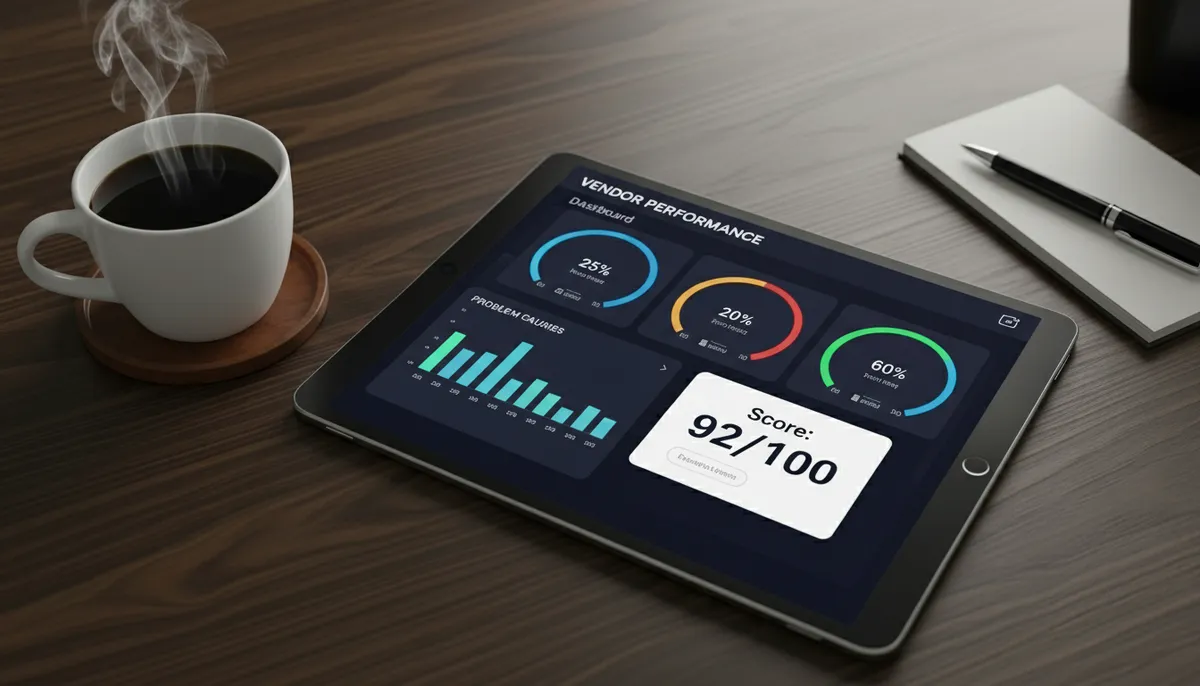
Table of Contents
Vendor Performance Scorecard Templates: A Practical Guide to Measuring Success
In the complex world of procurement, the adage “you can’t manage what you don’t measure” has never been more relevant. Yet, many organizations still rely on gut feelings or anecdotal evidence to evaluate their suppliers. A vendor might “feel” reliable because the account manager is friendly, even if their delivery times are slipping. To move from subjective opinions to objective data, you need a standardized tool. This tool is the vendor performance scorecard.
A well-designed scorecard removes ambiguity from your relationships. It provides a consistent framework for evaluating partners against agreed-upon standards, allowing you to track trends over time and hold vendors accountable. More than just a grading sheet, the scorecard serves as the data-driven foundation for a broader Vendor Relationship Management (VRM) strategy. By quantifying performance, you transform difficult conversations into constructive, fact-based collaborations that drive mutual growth.
The Anatomy of an Effective Scorecard: What to Measure
A robust scorecard acts as a dashboard for the health of your partnership. While specific metrics will vary by industry, every comprehensive scorecard should cover four core pillars of performance. Focusing solely on one area such as cost, can create a blind spot that hides risks in quality or compliance. For a deep dive into specific metrics, you can refer to our guide on measuring vendor performance KPIs, but generally, your scorecard should balance the following categories:
-
Operational Performance (Quality & Delivery): This is the baseline of the relationship. It measures whether the vendor is doing what they were hired to do. Metrics here include on-time delivery rates, error rates, adherence to Service Level Agreements (SLAs), and the quality of goods or services received. If a vendor fails here, the relationship is fundamentally broken, regardless of how cheap they are.
-
Financial Value (Cost & Billing): Beyond the initial price, this pillar evaluates total cost competitiveness and financial accuracy. It includes metrics like price stability (avoiding unexpected hikes), billing accuracy (frequency of invoice errors), and the vendor’s willingness to collaborate on cost-reduction initiatives.
-
Relationship Health (Communication & Innovation): This qualitative pillar distinguishes a strategic partner from a transactional supplier. It evaluates the vendor’s responsiveness to inquiries, the quality of their customer support, and their proactive approach to problem-solving. For strategic vendors, you should also score their contribution to innovation: are they bringing new ideas to the table?
-
Risk & Compliance: As supply chains become more interconnected, third-party risk grows. This section tracks adherence to regulatory requirements, security standards, and ethical sourcing policies. As outlined in our Vendor Risk Management Guide, tracking these metrics is essential for protecting your organization from reputational and legal damage.
Designing Your Rating Scale: Defining “Good” vs. “Great”
A scorecard is useless if the people filling it out have different definitions of success. One manager might give a “5” for doing the bare minimum, while another reserves a “5” for miraculous performance. To ensure consistency across your organization, you must define a clear rating key. A standard 1-5 scale is industry best practice because it offers enough nuance without being overly complex. Use the table below to define what each score represents:
| Score | Definition | Description |
| 5 | Exceptional | Consistently exceeds expectations, adds strategic value, and requires zero management intervention. |
| 4 | Above Average | Meets all requirements and frequently exceeds expectations; proactive communication. |
| 3 | Meets Expectations | Reliable performance; meets agreed SLAs and contract terms; no major issues. |
| 2 | Needs Improvement | Inconsistent performance; minor issues require frequent follow-up; corrective action plan needed. |
| 1 | Unacceptable | Critical failures; significant impact on operations; immediate executive escalation required. |
Template Examples: One Size Does Not Fit All
Attempting to use the same scorecard for your office supply vendor and your strategic IT partner will result in skewed data. It is important to tailor the complexity of the scorecard to the strategic importance of the vendor. Below are two structural examples you can adapt.
Template 1: The “Tactical” Scorecard (Simple)
This template is best suited for tactical or commodity vendors where the relationship is transactional. The goal here is efficiency and compliance. You are answering the question: “Is this vendor doing the job without causing headaches?”
-
Frequency: Annual or Bi-Annual
-
Format: Unweighted Average
-
Key Sections:
-
Delivery: Was the product/service delivered on time? (Yes/No/Partial)
-
Quality: Were there any defects or errors? (Rate 1-5)
-
Cost: Was the invoice accurate and the price consistent? (Rate 1-5)
-
Customer Service: Is the vendor responsive to issues? (Rate 1-5)
-
Overall Score: (Average of above)
-
Template 2: The “Strategic” Weighted Scorecard (Advanced)
This template is designed for your critical partners. Here, not all metrics are equal as innovation and reliability might be more valuable than a slight difference in cost. By assigning weights to each category, the final score reflects your strategic priorities.
-
Frequency: Quarterly (aligned with QBRs)
-
Format: Weighted Score
-
Key Sections & Weighting:
-
Operational Excellence (40%): Strict adherence to SLAs and quality standards.
-
Relationship & Innovation (30%): Proactive account management and continuous improvement ideas.
-
Financial Value (20%): Total cost of ownership and billing accuracy.
-
Risk & Compliance (10%): Up-to-date certifications and data security adherence.
-
Overall Score: (Sum of weighted category scores)
-
From Spreadsheet to Strategy: Using the Scorecard
Collecting the data is only half the battle: the value lies in how you use it. A scorecard should never be a document that is filed away and forgotten. Instead, it should serve as the primary agenda item for your Quarterly Business Review (QBR).
Before the meeting, share the scorecard with the vendor. This transparency prevents surprises and allows the vendor to prepare. During the review, focus the discussion on trends. If a vendor has dropped from a “4” to a “3” in communication over two quarters, that is a trend worth discussing before it becomes a crisis. Use the scorecard to celebrate wins, identify gaps, and mutually agree on an action plan for the next quarter.
How Vendorfi Automates Your Scorecards
The biggest challenge with manual scorecards is the administrative burden. Chasing stakeholders for feedback, manually calculating weighted averages in spreadsheets, and digging through emails to find old invoices is time-consuming and prone to error. Vendorfi transforms this process by automating data collection and visualization.
Automated data aggregation
Vendorfi connects with your procurement and financial systems to automatically pull quantitative data such as on-time delivery rates and invoice accuracy, directly into the vendor profile. You can then trigger automated surveys to internal stakeholders to capture qualitative feedback on relationship health.
Real-time visualization of performance trends
Instead of a static snapshot, Vendorfi provides dynamic dashboards that visualize performance over time. You can instantly see if a strategic partner’s performance is trending up or down, allowing you to intervene proactively rather than reacting to a failed renewal or a supply chain disruption.
Conclusion: Data-Driven Decisions Build Better Partnerships
A vendor performance scorecard is more than a report card but a tool for alignment. By clearly defining success, measuring it consistently, and discussing it openly, you remove the friction from vendor management. Whether you use a simple checklist for tactical suppliers or a weighted dashboard for strategic partners, the result is the same: data-driven decisions that build stronger, more resilient supply chains.
Frequently Asked Questions (FAQ)
How often should I update a vendor scorecard?
For strategic vendors, scorecards should be updated quarterly to align with your QBR schedule. For tactical or lower-risk vendors, an annual or bi-annual review is usually sufficient to ensure they are still meeting basic requirements.
Should I share the scorecard with the vendor?
Yes, absolutely. Transparency is key to a collaborative relationship. Sharing the scorecard helps the vendor understand exactly how they are being evaluated and where they need to improve. It transforms the relationship from adversarial to collaborative.
What is the difference between a KPI and a Scorecard?
A KPI (Key Performance Indicator) is a single metric, such as “On-Time Delivery Rate.” A Scorecard is a document or dashboard that aggregates multiple KPIs and qualitative data points to provide a comprehensive view of the vendor’s overall health and performance.
Manage your entire vendor lifecycle, from procure to pay - for free.
See how Vendorfi's automated platform can help you manage risk and reduce spend across your entire vendor portfolio.