

Vendor Offboarding Checklist: Compliance Steps for Data Deletion, Access Removal & DPA Termination

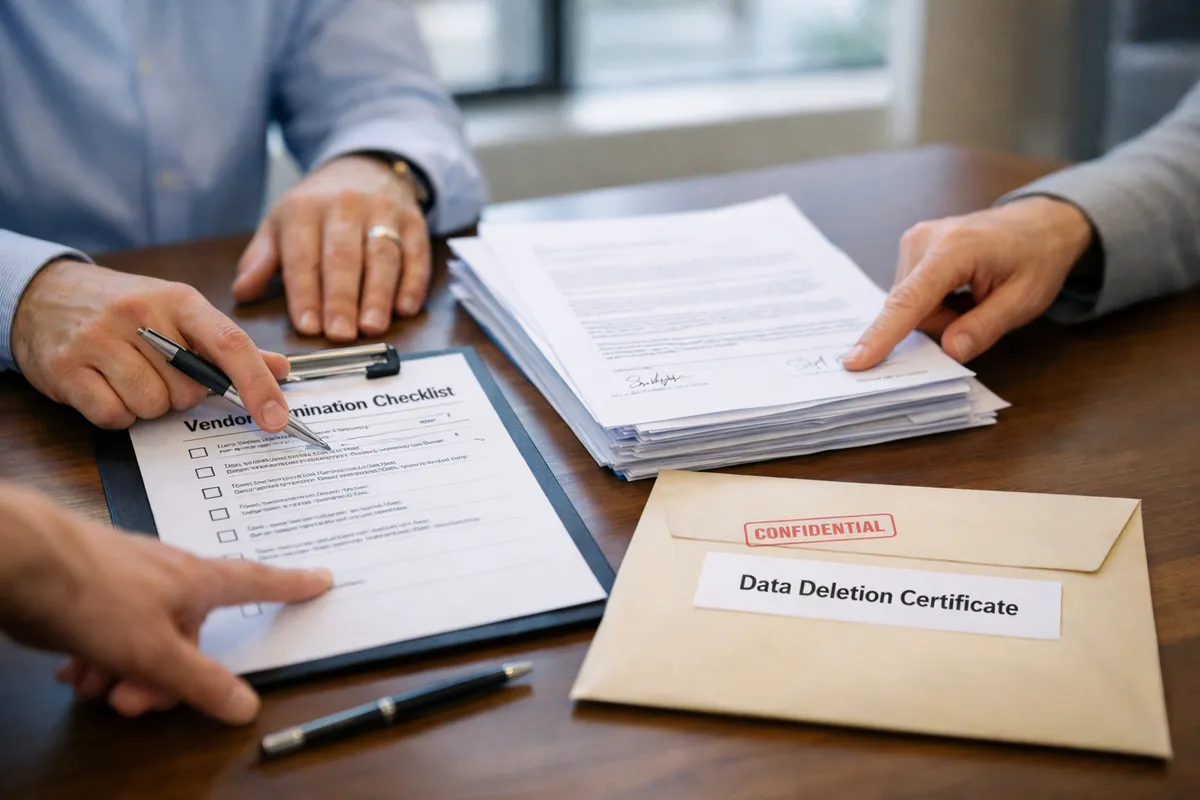
Table of Contents
Quick answer: What is compliance-first vendor offboarding?
A structured exit process ensuring all data is returned or deleted, system access fully revoked, contractual obligations closed, and audit-ready evidence retained, reducing legal, security, and financial risk after a vendor relationship ends.
Vendor lifecycle management doesn’t end at contract signature. For SMEs, the highest-risk phase is often the exit: when a vendor relationship terminates but access persists, data lingers in backups, or compliance obligations go unfulfilled. This diagnostic checklist helps procurement, finance, and operations teams audit their offboarding process against regulatory requirements and operational best practices so you close vendor relationships cleanly, defensibly, and without hidden exposure.
Vendor Offboarding in Vendor Lifecycle Management: Compliance Essentials
Vendor offboarding is the formal process of terminating a business relationship and systematically removing all associated privileges, data holdings, and contractual obligations. It’s distinct from contract expiration because it requires active verification, not just passive lapse.
For SMEs handling personal data, financial records, or regulated information, offboarding triggers specific compliance duties. GDPR Article 28(3)(g)[^1], CCPA/CPRA, SOC 2, and ISO 27001 all require documented proof that vendor-held data was returned, deleted, or anonymized at termination. Ignoring these steps creates audit findings, regulatory fines, or breach liability.
If you’re building a complete vendor program, pair this exit checklist with our guide to effective vendor onboarding to cover the full relationship arc.
When to Trigger Offboarding: Termination Scenarios
Offboarding isn’t only for contentious exits. Proactive termination scenarios include voluntary non-renewal after a successful contract, strategic vendor replacement, or organizational changes like mergers. Reactive triggers include repeated SLA breaches, security incidents, cost overruns without value justification, or regulatory changes that make a vendor non-compliant.
Checklist: 5 Signals It’s Time to Offboard
-
☐ Repeated SLA breaches with no remediation plan
-
☐ Security incident or data breach involving the vendor
-
☐ Strategic misalignment (vendor no longer fits your roadmap)
-
☐ Cost overrun exceeding 15% without documented value
-
☐ Regulatory change rendering the vendor non-compliant
Understanding these triggers early lets you prepare evidence requests and access inventories before notice is sent. For broader risk context, review your vendor risk management framework to align offboarding decisions with enterprise risk appetite.
Offboarding Workflow: Owners, Stage Gates & Timeline
A defensible offboarding process requires clear ownership and time-bound deliverables. Procurement manages contract notices, Legal handles DPA obligations, IT/Security executes access revocation, Finance reconciles final payments, and Compliance archives evidence. Without this RACI structure, tasks fall through the cracks.
The critical path typically runs: Day 0 (notice sent) → Day 3 (access inventory) → Day 7 (access revoked) → Day 30 (data disposition verified) → Day 45 (financial close) → Day 90 (evidence locked). Compressing or skipping stages increases residual risk.
Table: Offboarding Stage Gate Checklist
| Stage | Owner | Key Deliverable | Deadline | Verification Method |
|---|---|---|---|---|
| Notice Sent | Legal/Procurement | Signed termination letter | Day 0 | Email receipt + read confirmation |
| Access Audit | IT/Security | Inventory of all vendor access | Day 3 | System logs + SSO report |
| Access Revoked | IT/Security | Confirmation of deprovisioning | Day 7 | Audit logs + penetration spot-check |
| Data Disposition | Legal/DPO | Certificate of deletion/return | Day 30 | Signed attestation + hash verification |
| Financial Close | Finance | Final settlement document | Day 45 | Signed PO closure + credit memo |
| Evidence Archive | Compliance | Immutable audit package | Day 90 | Hash-verified storage + access log |
Document this workflow in your vendor management SOP template to ensure repeatability across exits.
Access Removal: Revoke Accounts, API Keys, SSO & Privileged Roles
Access creep is the most common offboarding failure. Vendors often retain human accounts, service credentials, API keys, SSO federations, or physical badges long after contract end. ISO 27001 Control A.6.5[^3] explicitly requires defining security responsibilities that survive termination and access revocation is core evidence for auditors.
Start with a comprehensive inventory: check identity providers, cloud consoles, integration platforms, backup systems, and physical access logs. Then execute revocation in parallel tracks: disable SSO federations first, followed by local accounts, then service credentials. Finally, verify via audit logs and spot-check penetration tests.
Listicle: 7 Access Types Vendors Often Forget to Revoke
-
Shared service accounts (e.g.,
vendor@company.com) -
API keys embedded in staging or test environments
-
Webhook endpoints still accepting vendor payloads
-
Backup system credentials with vendor read/write access
-
Physical badges or facility access tokens
-
Third-party integration tokens (Zapier, Make, etc.)
-
Legacy SSO federations not decommissioned in your IdP
Verification matters more than execution. Request timestamped logs showing deprovisioning, and consider a brief external scan to confirm no residual endpoints remain accessible.
Data Return & Deletion: Verification Steps and Proof to Request
Your Data Processing Agreement (DPA) should specify whether vendor-held data must be returned, deleted, or anonymized at termination. GDPR Article 28(3)(g)[^1] requires processors to “return or destroy” personal data unless EU/Member State law requires storage. CCPA/CPRA and sectoral rules (HIPAA, FINRA) add parallel obligations.
Request evidence aligned with your regulatory framework. NIST 800-88[^2] and IEEE 2883 both require documented proof of sanitization, typically a certificate of media disposition. While SOC 2 doesn’t explicitly mandate certificates, auditors widely accept them as strong evidence for security and confidentiality criteria.
Table: Data Disposition Requirements by Regulation
| Regulation | Deletion Standard | Proof Required | Retention of Evidence |
|---|---|---|---|
| GDPR (EU) | Art. 28(3)(g): return or destroy | Written confirmation + technical logs | As long as processing justification exists |
| CCPA/CPRA (CA) | “Delete” per consumer request | Signed attestation + method description | 24 months for compliance records |
| SOC 2 | CC6.1: logical access removal | Access revocation logs + change tickets | 1-3 years (audit cycle dependent) |
| HIPAA (§164.310) | Secure disposal of ePHI | Certificate of destruction + witness signature | 6 years from creation/date of last use |
| ISO 27001 (A.6.5) | Responsibilities after termination | Updated access matrix + role reassignment log | Per organizational policy (typically 3 years) |
For GDPR-specific workflows, cross-reference our GDPR DPA checklist to ensure your termination language covers all required clauses. When in doubt, request hash-verified deletion logs, as they provide cryptographic proof that’s difficult to dispute.
Contract & DPA Termination: Notices, Obligations, and Timelines
Contract termination mechanics matter. Notices must follow the delivery method specified in your agreement (email, certified mail, portal), include the effective date, and reference the specific termination clause. Keep proof of delivery such as read receipts, tracking numbers, or portal timestamps for audit defense.
Certain clauses survive termination: confidentiality, indemnity, audit rights, and data return/deletion obligations. Your DPA should explicitly state that the processor’s duty to assist the controller (e.g., responding to data subject requests) continues for a defined period post-termination.
Snippet: DPA termination in practice
DPA termination requires written notice, confirmation of data deletion/return per Art. 28(3)(g), and acknowledgment that surviving clauses (confidentiality, indemnity, audit rights) remain enforceable. Retain proof for regulatory audits.
Subprocessor relationships add complexity. Require your vendor to provide written confirmation that downstream processors have also deleted or returned your data. If the vendor is unresponsive or insolvent, escalate to your DPO or legal counsel to assess direct notification duties under applicable privacy laws. For foundational compliance context, see our vendor compliance guide.
Subprocessor & Downstream Data Considerations
Modern vendors rarely process data in isolation. They engage subprocessors for hosting, analytics, support, or specialized functions. Your offboarding checklist must account for this chain.
Before sending termination notice, request an updated subprocessor list covering the entire contract term. Then require written confirmation that each subprocessor has completed data disposition per your instructions. Document any refusals or delays because these become critical evidence if regulators inquire later.
If mapping reveals high-risk subprocessors (e.g., those handling sensitive data in jurisdictions with weak privacy protections), consider escalating to your Data Protection Officer. In extreme cases, you may need to notify affected data subjects directly, depending on breach notification thresholds in your jurisdiction.
Financial Closeout: Final Invoices, Credits & Liability Resolution
Unresolved financials can derail offboarding. Reconcile all outstanding purchase orders, unused credits, penalty clauses, and warranty claims before signing final settlement. Document any disputes in a dedicated log to protect you if the vendor later alleges non-payment.
Finance should provide written sign-off confirming: (1) all invoices received and processed, (2) credits applied or refunded, and (3) no outstanding liabilities except those explicitly reserved. This document becomes part of your audit evidence package.
For context on how structured vendor management reduces financial exposure, review how a VMS mitigates legal and financial risks across the lifecycle and not just at exit.
Evidence Retention: What to Keep for Audits and Disputes
Retention periods vary by regulation and data type. GDPR requires keeping processing records as long as justification exists; HIPAA mandates six years; SOC 2 audits typically examine 1-3 years of evidence. Document your rationale and align with the longest applicable requirement.
Store evidence in immutable formats: hash-verified PDFs, write-once logs, or blockchain-anchored records. Limit access to the archive and log all retrieval attempts. This protects integrity if evidence is challenged later.
Checklist: 6 Documents Every SME Should Archive Post-Offboarding
-
☐ Signed termination notice with delivery proof
-
☐ Access revocation audit log (timestamped)
-
☐ Data deletion/return certificate (NIST 800-88 compliant)
-
☐ Final financial settlement + credit memo
-
☐ DPA acknowledgment of surviving obligations
-
☐ Lessons-learned memo for process improvement
Copy/Paste Offboarding Checklist (Diagnostic Scorecard)
Use this scorecard to assess your current offboarding maturity. Rate each capability as Basic (ad-hoc), Defined (checklist-driven), or Integrated (automated). Target “Defined” as a minimum for compliance-ready SMEs.
Pre-Termination Prep
-
☐ Updated subprocessor inventory obtained
-
☐ Access inventory completed across all systems
-
☐ Data disposition path selected per DPA and regulation
-
☐ Termination notice drafted per contract terms
Execution Phase
-
☐ Notice sent with delivery proof retained
-
☐ SSO federations and local accounts disabled
-
☐ API keys, webhooks, and service credentials revoked
-
☐ Data deletion/return certificate requested and received
Post-Close Verification
-
☐ Access revocation verified via audit logs
-
☐ Financial settlement signed and archived
-
☐ Evidence package stored in immutable format
-
☐ Lessons-learned memo shared with procurement/legal
Table: Offboarding Maturity Diagnostic
| Capability | Basic (Ad-hoc) | Defined (Checklist) | Integrated (Automated) |
|---|---|---|---|
| Access Revocation | Manual, email-based | Ticketed workflow with SLA | Auto-deprovision via IdP sync |
| Data Verification | Verbal confirmation | Signed attestation requested | Hash-verified deletion logs |
| Evidence Retention | Scanned PDFs in shared drive | Immutable storage with access log | Blockchain-verified audit trail |
| Subprocessor Tracking | Not performed | Vendor provides subprocessor list | Automated mapping + notification |
Benchmark your program against broader procurement maturity using our procurement process assessment scorecard.
Conclusion
Vendor offboarding is where compliance commitments meet operational reality. A diagnostic, evidence-based approach rather than a reactive checklist. It reduces legal exposure, strengthens audit posture, and protects your organization long after the contract ends.
Start with the stage gate table and maturity scorecard above. Then integrate these steps into your broader vendor lifecycle management program. For SMEs seeking to automate vendor analysis and risk scoring at scale, Vendorfi combines AI-powered insights with compliance-ready workflows, so you can offboard with confidence, not guesswork.
FAQ
What is the first step in compliant vendor offboarding?
Review your contract and DPA for notice requirements, data disposition obligations, and surviving clauses. Then inventory all access types and data holdings before sending formal notice.
How do we verify a vendor actually deleted our data?
Request a certificate of sanitization aligned with NIST 800-88[^2] or IEEE 2883, including erasure method, asset IDs, and verification status. For high-risk data, require hash-verified logs or third-party attestation.
Do we need to notify customers when offboarding a data-processing vendor?
Generally no, unless the offboarding follows a reportable breach or your privacy policy commits to such notifications. Consult your DPO or legal counsel for jurisdiction-specific advice.
What clauses should survive contract termination for compliance protection?
Confidentiality, indemnity, audit rights, and data return/deletion obligations should explicitly survive. Ensure your DPA specifies the processor’s continuing duty to assist with data subject requests.
How long should we retain offboarding evidence for audits?
Align with the longest applicable requirement: GDPR (as long as processing justification exists), HIPAA (6 years), SOC 2 (1-3 years). Document your rationale and store evidence immutably.
Can we offboard a vendor if they’re unresponsive or insolvent?
Yes, but escalate to legal/DPO immediately. Document all contact attempts, preserve evidence of termination notice delivery, and assess whether direct notification to subprocessors or data subjects is required.
Manage your entire vendor lifecycle, from procure to pay - for free.
See how Vendorfi's automated platform can help you manage risk and reduce spend across your entire vendor portfolio.