

Procurement Process Assessment: A 30-Minute Maturity Audit

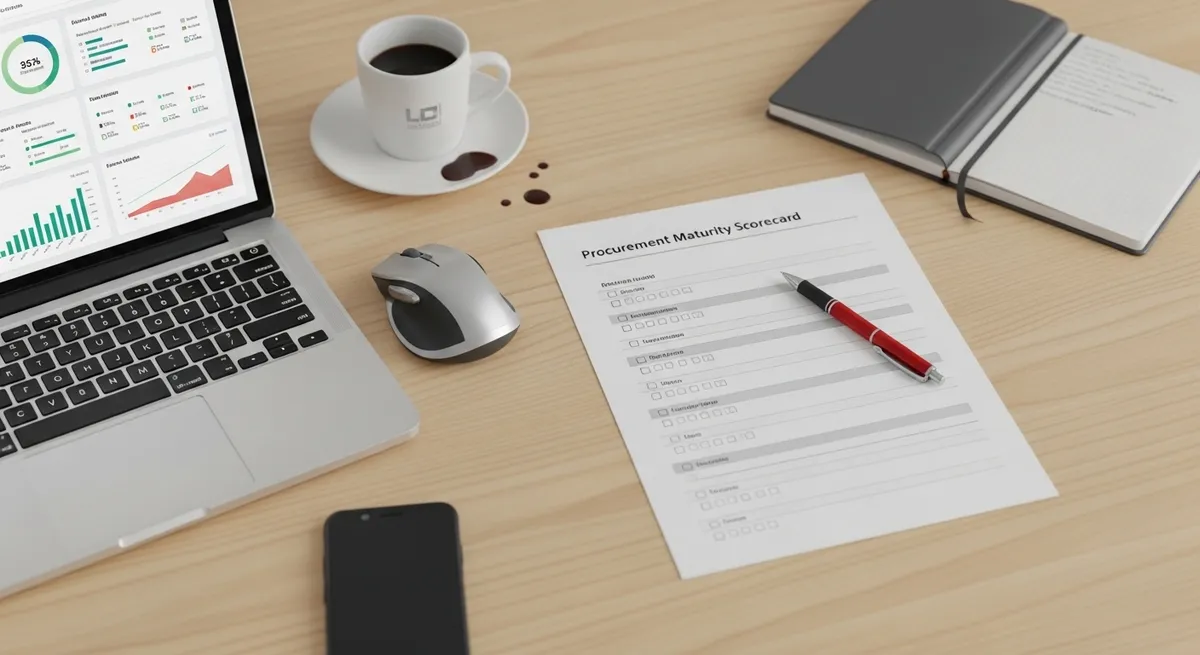
Table of Contents
Procurement Process Assessment: The Lightweight Maturity Scorecard for SMEs
You can’t fix what you can’t measure. For many SMEs, procurement isn’t a “process”, it’s a series of reactive emails, Slack messages, and credit card swipes. While this agile approach works in the early days, it eventually breeds chaos: maverick spend, duplicate vendors, and invisible risks.
A procurement process assessment is your diagnostic tool to stop the bleeding. It isn’t about creating bureaucratic red tape, it is about identifying where money is leaking and where risks are hiding.
This guide provides a lightweight, 30-minute maturity audit designed specifically for Ops teams and business owners. No expensive consultants required, just honest answers and a look at your data.
What is a Procurement Process Assessment? (And When to Run One)
A procurement process assessment is a structured evaluation of how your organization buys goods and services. Unlike a financial audit, which looks at where the money went, a process assessment looks at how decisions were made, who made them, and what controls were in place.
For SMEs, this shouldn’t be a six-month project. It should be a rapid diagnostic to baseline your current maturity against best practices.
5 Signs Your Process is Broken
If you recognize any of these symptoms, it is time to run this assessment:
-
Maverick Spend: Employees are buying software or services without approval, and you only find out when the invoice arrives.
-
Vendor Duplication: You have three different marketing agencies or five different SaaS tools doing the same job.
-
Onboarding Bottlenecks: It takes weeks to get a new vendor approved because the “process” is buried in email chains.
-
Invoice Discrepancies: Finance spends hours every month chasing Ops teams to figure out who ordered what.
-
Zero Audit Trail: If an auditor asked for the contract and approval for a specific vendor, you couldn’t produce it within an hour.
The 6 Dimensions to Assess
To get a clear picture of your procurement health, you must evaluate six distinct dimensions. A failure in one usually triggers failures in others.
-
Process: The workflow from “I need this” to “Invoice paid.” Is it documented? Is it followed?
-
People: Who buys? Do they have the skills and authority? Is there clear ownership?
-
Data: The quality of your vendor master file. Is spend data categorized, clean, and accessible?
-
Controls: The guardrails. Do you have approval hierarchies? Are GDPR data processing agreements tracked?
-
Systems: The tech stack. Are you running on email/Excel (Level 0) or a dedicated platform?
-
Vendors: How you manage relationships. Do you categorize vendors using the Kraljic Matrix?
Maturity Levels (0-4) with Observable Behaviors
Before you score yourself, understand where you fit on the maturity spectrum. Most SMEs start at Level 0 or 1.
| Level | Name | Observable Behavior |
| 0 | Non-Existent | Buying is a “free-for-all.” No defined process. Corporate cards are shared freely. No central record of vendors. |
| 1 | Ad-Hoc | A basic policy exists but is rarely followed. “Process” depends on who is asking. Everything is done via email/spreadsheet. |
| 2 | Defined | Written SOPs exist. There is a central vendor list (likely Excel). Approvals are manual but required over certain thresholds. |
| 3 | Integrated | Technology enforces the process. Vendor onboarding is automated. Spend data is visible in real-time. |
| 4 | Optimized | Continuous improvement. Predictive analytics on spend. Strategic vendor partnerships and automated performance scorecards. |
The 30-Minute Scorecard (Questions + Scoring)
Grab a pen or open a spreadsheet. Rate your organization on a scale of 1 (Strongly Disagree) to 5 (Strongly Agree) for each statement.
Section 1: Process & Controls
-
We have a clearly documented purchasing policy that all employees can access.
-
All purchases over a specific threshold require pre-approval (not retroactive).
-
We can easily verify if a service was actually delivered before paying the invoice.
-
Emergency purchases have a specific, documented workflow.
-
Score (out of 20): __
Section 2: Data & Systems
-
We have a single, centralized “Source of Truth” for all vendor data (contracts, contacts, tax forms).
-
We do not rely on email chains to approve new vendors or purchases.
-
We can generate a spend report by category within 10 minutes.
-
Our systems alert us before a contract auto-renews.
-
Score (out of 20): __
Section 3: Vendor Management
-
Every active vendor has a signed, valid contract on file.
-
We perform basic due diligence (legal/finance checks) before onboarding a vendor.
-
We classify vendors by risk and strategic importance.
-
We review vendor performance at least annually for key suppliers.
-
Score (out of 20): __
Total Score (out of 60): __
Evidence Checklist: What to Review
Don’t just guess your score. Validate it by asking for these 5 items. If you can’t produce them, lower your score.
-
[ ] The Vendor Master File: Is it a clean database, or a messy spreadsheet with duplicates and missing tax IDs?
-
[ ] The Last 10 POs: Look at the dates. Was the PO created before the invoice date, or was it a “confirming order” created just to get the bill paid?
-
[ ] Contract Repository: Pick 3 active vendors. Can you find their signed contracts and Data Processing Agreements immediately?
-
[ ] Approval Matrix: Is there a document defining who can sign off on $5k vs $50k?
-
[ ] Onboarding Form: Do you have a standard intake form, or do vendors just email bank details to Finance?
How to Interpret Your Results
-
0-25 (Critical Risk): Your business is leaking money. Fraud risk is high, and you likely have significant “zombie spend” (paying for services you don’t use). Immediate action is required.
-
26-45 (Growing Pains): You have the basics, but they aren’t scalable. As you grow, the manual workload will drown your Ops team. You need to transition from “people-dependent” to “system-dependent.”
-
46-60 (Mature): You have a solid foundation. Focus on optimization, such as automating vendor performance scorecards and strategic sourcing.
Fix-Priority Matrix: Impact vs. Effort
Once you identify the gaps, you can’t fix everything at once. Use this matrix to prioritize.
| Priority | Category | Action Items | Impact | Effort |
| 1 | Quick Wins | Centralize the Vendor Master File; Define an Approval Matrix. | High | Low |
| 2 | Major Projects | Implement a Vendor Management System (VMS); renegotiate key contracts. | High | High |
| 3 | Fill-ins | Update handbook wording; organize legacy digital files. | Low | Low |
| 4 | Money Pits | Building custom procurement software; detailed audits of $50 office supply purchases. | Low | High |
A 30/ 60/ 90-Day Remediation Plan
Moving from “Ad-Hoc” to “Integrated” doesn’t require a massive ERP implementation. Here is a sprint plan for SMEs.
Days 1-30: Stop the Bleeding (Quick Wins)
-
Goal: Visibility and basic control.
-
Action: Build your Vendor Master File. Gather all active contracts and contacts into one secure location.
-
Tooling: If you are drowning in spreadsheets, this is where Vendorfi helps immediately by acting as a central repository for vendor data and contracts, eliminating the version control nightmare of Excel.
-
Policy: Publish a simple “Who Can Buy What” one-pager.
Days 31-60: Standardization
-
Goal: Consistent processes.
-
Action: Implement a standard vendor intake form. Stop accepting vendors via email.
-
Action: Enforce the “No PO, No Pay” rule for purchases over $1,000.
-
Risk: conduct a basic vendor risk assessment for your top 10 suppliers.
Days 61-90: Systematization
-
Goal: Automation and efficiency.
-
Action: Automate the approval workflow. Instead of chasing managers for signatures, use a system that routes requests based on budget.
-
Action: Set up renewal alerts. Ensure you never get auto-renewed for a tool you wanted to cancel.
Governance: Cadences, Owners, and KPIs
To prevent backsliding into chaos, assign a “Process Owner” (usually a Head of Ops or Finance) and track these three KPIs monthly:
-
% Spend Under Management: What percentage of spend goes through the approved process/contracted vendors? (Target: >80%).
-
PO Cycle Time: How long does it take to get from request to order? (Target: <48 hours).
-
Vendor Compliance Rate: Percentage of active vendors with valid tax forms and insurance on file.
Frequently Asked Questions (FAQ)
How often should we run a procurement process assessment?
For high-growth SMEs, run a lightweight assessment (like this one) every 6 months or whenever headcount grows by 20%.
Do I need a consultant to do this?
No. For most SMEs, an internal audit by the Ops or Finance lead is sufficient. Consultants are typically needed only for large enterprises with complex supply chains.
What is the difference between an audit and an assessment?
An audit usually refers to a financial compliance check (verifying numbers). An assessment evaluates the health and maturity of the operational process itself.
How does software help improve the assessment score?
Software like Vendorfi automatically moves you up the maturity curve by enforcing workflows, centralizing data, and creating audit trails that are impossible to maintain manually in spreadsheets.
Ready to improve your maturity score? Start by centralizing your vendor data with Vendor today.
Manage your entire vendor lifecycle, from procure to pay - for free.
See how Vendorfi's automated platform can help you manage risk and reduce spend across your entire vendor portfolio.